How to Tell if Your Roof Has Hail Damage
Some hail damage shows from the driveway, but most of it doesn't, and that gap is the reason to look closer after a storm.
October 1, 2026 · 4 min read
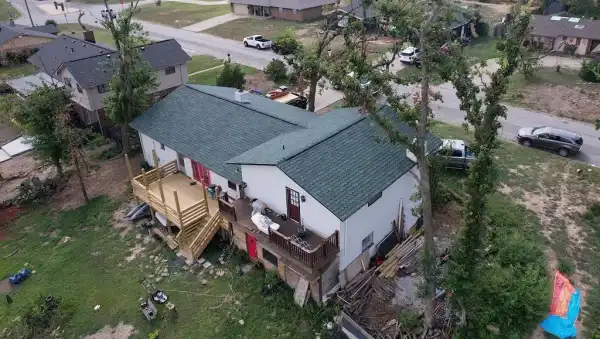
After a hailstorm in Northwest Arkansas, most homeowners do the same thing. They walk the yard, look up at the roof, see nothing obvious, and go back inside. Sometimes that's the right call. Often it isn't, because the damage that matters most on a roof is hard to read from the ground.
This guide covers what you can reasonably check yourself, what you can't, and why a proper inspection after a significant storm makes sense even when nothing is dripping through your ceiling.
What you can and can't see from the ground
From the yard you're looking at the roof from a long way off and at a steep angle. Shingles are dark, textured and often weathered, so fresh hail marks blend into everything else. A bruise on an asphalt shingle, where the hail has knocked granules loose and left a soft spot underneath, usually isn't visible from below. Neither are small cracks in the shingle mat or hits along a ridge cap.
What you can often see from the ground is the secondary evidence. Start with the things hail hits first, because they're softer than shingles and hold their marks more clearly:
- Dents or dings in metal roof vents, ridge vents and turbine vents
- Dents in flashing, drip edge and chimney caps
- Dents, dings or dimples in gutters and downspouts, especially on the side of the house that faced the storm
- Marks on window screens, garage doors, siding, the mailbox and outdoor furniture
- Stripped leaves and bark on the side of the trees that faced the wind
None of these proves the shingles are damaged, and the lack of them doesn't prove the roof is fine. But when the soft metals around your house took hits, the roof surface took hits from the same storm. That's a good reason to have someone look at it properly.
Granule loss and what it tells you
Asphalt shingles are covered in mineral granules. They shield the asphalt layer underneath from sun and wear. Hail can knock granules off in patches, and a spot that has lost its granules can age faster than the roof around it.
After a storm, look at where your downspouts empty. A noticeable pile of granules at the outlet, like coarse dark sand, is worth mentioning to an inspector. Some granule loss is normal on an older roof, so the pattern matters. Scattered loss across the whole roof tells a different story than a cluster of bare spots on the slope that faced the storm.
Flashing, vents and the roofline
Flashing is the metal that seals the places where the roof meets something else: chimneys, walls, skylights, valleys and pipe penetrations. It's thin, so it dents easily and keeps a record of what the storm did. Dented flashing, a bent drip edge or a chimney cap with fresh dimples all help an inspector work out which direction the hail came from and how hard it fell.
Vents and pipe boots deserve a look too. Plastic and rubber parts can crack or split under hail, and a split boot is the kind of small opening that lets water in on the next hard rain.
Gutters and downspouts count
Gutters and downspouts take hail on every exposed surface, and they're easy to check from the ground. Look for dents along the front edge, dimpled downspouts and any seam that has pulled apart. Roofing & Gutter Experts inspects gutters and downspouts for hail damage as part of a storm inspection, because they often show the direction and strength of a storm more clearly than the shingles do.
Why inspect when nothing is leaking
A roof can be damaged long before it leaks. Hail can bruise a shingle, and the water gets in months later, after wind-driven rain and ordinary wear have worked on the weak spot. By the time a stain shows up on the ceiling, water may have been reaching the decking and insulation for a while. Waiting for a leak means learning about storm damage the hard way.
There's a practical reason, too. If you do end up making an insurance claim, having the roof inspected and the visible damage documented soon after the storm gives you photos and notes tied to a real event, instead of a guess about what happened and when. The carrier still decides coverage and payment, but good documentation is where that conversation starts.
What a good inspection covers
A thorough inspection looks at the whole property, not only the roof surface. That means each slope, the ridge, the flashing, the vents, the gutters and downspouts, and the other soft metals that show the storm's direction. It should end with photos of what was found and a plain explanation of it, including the parts of the roof that look fine.
- Each roof slope, checked for bruising, cracks, creases and missing or lifted shingles
- Flashing, vents, chimney caps and drip edge
- Gutters and downspouts
- Photos of visible damage, with measurements when they're useful
- A clear explanation of what the inspector saw and what your options are
If you can't tell whether the last storm hurt your roof, that uncertainty is the answer. The Storm Damage page explains how Roofing & Gutter Experts handles inspections and documentation for homeowners in Springdale, Fayetteville, Rogers, Bentonville, Bella Vista and Centerton. When you're ready to set one up, the Contact page has a form, or you can call 479-435-3837. The line is open 24 hours.
Roofing & Gutter Experts, 479-435-3837
Call 479-435-3837More articles
What Happens at a Free Roof Inspection After a Storm
Knowing the four stages ahead of time makes the visit easier and helps you ask better questions.
Class 4 Shingles: What the Rating Means
Class 4 is a real step up in impact resistance, and it is still not a promise that hail can't hurt your roof.